The Department of Justice (DOJ) and the DEA recently rescheduled marijuana, moving FDA-approved and state-regulated medical marijuana products to Schedule III of the Controlled Substances Act.1
For years, there has been much discussion regarding the rescheduling of marijuana. As a Schedule I controlled substance, marijuana faced various restrictions surrounding clinical research, drug development, medical utilization and reimbursement, and more. This monumental change now makes it important for stakeholders to assess policy, utilization and operational impacts.
It is worth noting that this change effectively reschedules only medical marijuana and not recreational marijuana. At the federal level, marijuana is still illegal and subject to strict controls, though regulatory wheels are moving to evaluate a potential broader rescheduling.1
Drug scheduling directly determines how medications are prescribed, monitored, reimbursed, and operationalized within pharmacy and claim systems.
According to the DEA, certain drugs are classified into five distinct schedules depending upon the drug’s acceptable medical use and the drug’s abuse or dependency potential.2 Schedule I has no accepted medical use and the highest abuse or dependency potential, while Schedule V has the most acceptable medical use and the lowest abuse or dependency potential.
Schedule III drugs can be dispensed by a pharmacist, pursuant to a prescription authorized by a healthcare practitioner, or administered or dispensed directly by a medical practitioner in the course of their professional practice, though various prescription limits still exist.3
At this time, raw marijuana and a majority of currently available medical marijuana products are not FDA-approved drugs. These items could not be prescribed or dispensed at a pharmacy. However, marijuana-derived drugs could be prescribed and dispensed by pharmacists if they are approved by the FDA. This is particularly noteworthy as the rescheduling of marijuana now allows for greater clinical research, which could lead to such FDA-approved products.
Rescheduling marijuana may influence marijuana utilization patterns via two different pathways – each carrying very different implications for clinical consistency, reimbursement, and utilization management.


First, the reduction of restrictions for clinical research is anticipated to accelerate drug development and support evidence-based FDA oversight of marijuana-derived products. Such drugs could then be prescribed and dispensed like any other medication, backed by efficacy and safety data that prescribers could reference in clinical decision-making.

Second, because the rescheduling of marijuana acknowledges its potential for medical use, there may be an increase in provider willingness to recommend currently-available, non-FDA-approved medical marijuana products that are obtainable via state programs.
For decades, marijuana’s status as a Schedule I drug has created roadblocks for studying marijuana and developing a better understanding of its clinical properties. There is currently a lack of standardized clinical guidelines for marijuana, which creates challenges related to dosing, toxicity, product consistency, formulations and routes of administration, drug-drug and drug-disease interactions, and much more.
But now with Schedule III status, researchers face fewer restrictions in studying marijuana. While it could take years to generate enough data and insights to support broad scientific consensus, such information could further shape the clinical landscape. Additionally, fewer regulatory hurdles enables drug developers to pursue marijuana-derived medications, potentially resulting in FDA-approved medications coming to market. Once FDA-approved marijuana products become more widely available, their use would be subject to traditional prescribing, dispensing and monitoring practices under physician and pharmacists' oversight.
VER-01, a cannabis-derived medication, demonstrated positive results for the treatment of lower-back pain in two separate Phase 3 clinical trials (the stage prior to drug approval). One trial found VER-01 to be superior to opioids for pain reduction in patients with chronic low-back pain.4 While it remains to be seen if this drug will be approved, the fact that it tested so well prior to marijuana’s rescheduling indicates that the rescheduling of marijuana could open the floodgates to even more drug development.

To put marijuana’s rescheduling into perspective, an FDA-approved drug derived from marijuana would fall into Schedule III, while many opioid pain medications – such as hydrocodone, oxycodone, morphine, fentanyl, and methadone – currently fall into Schedule II.2
This means that such FDA-approved marijuana products would see fewer drug restrictions than opioids. For instance, Schedule II drugs cannot be refilled, instead requiring a new prescription, while Schedule III drugs are eligible for five refills within a six-month window.3
For prescribers, the rescheduling of marijuana – assuming it leads to FDA-approved products – would provide an additional therapeutic option for the treatment of chronic pain that has not been alleviated with more traditional therapies, and with fewer restrictions.
Considering the high-risk profile associated with opioids, it is possible that some prescribers could exhibit a preference for prescribing marijuana.
Approximately 40 states currently operate medical marijuana programs with varying regulations and qualifying conditions. Furthermore, states like New York, Illinois, and Colorado passed laws to enable patients to use medical marijuana as an opioid alternative, for conditions when an opioid might otherwise have been prescribed, with a certification from a physician.5-7
Despite the availability of these programs, provider participation remains relatively limited. For example, Florida has more than 90,000 MDs and DOs statewide, 8 yet only about 2% are qualified to recommend medical marijuana.9 Similarly, New York has more than 110,000 physicians,8 with roughly 4% registered to certify patients for medical cannabis.10 These figures suggest that, despite long‑standing state programs, authorization to recommend medical marijuana remains concentrated among a relatively small subset of providers.
Notably, these programs already operate within structured regulatory and oversight frameworks governing patient certification, dispensing, and use non-FDA-approved medical marijuana products. The rescheduling of marijuana may now further reduce barriers for providers who may have been reluctant to participate while cannabis remained a Schedule I substance.
This is especially relevant given that, even prior to rescheduling, many providers demonstrated a willingness to recommend marijuana in select circumstances.
An analysis of 21 peer-reviewed studies addressing providers’ experience and attitudes towards medical cannabis found that anywhere from 10-95% of the physicians were willing to prescribe and/or provide marijuana to patients, depending on setting, specialty and experience.11 This broad range highlights how localized policy, clinical context, and regulatory comfort play a significant role in provider behavior.
Another study surveyed 1,506 family practice doctors, internists, nurse practitioners, and oncologists, and 68.9% believed cannabis had medicinal use, while 26.6% had recommended cannabis to a patient. Among those who believed that cannabis had medicinal uses, 73.1% of clinicians surveyed believed that cannabis had medicinal use for pain.12
In workers’ comp, marijuana utilization most often emerges in high‑severity, long‑duration, and treatment‑refractory claims. Clinical and policy literature consistently positions cannabis as a non‑first‑line option, typically considered after conventional pharmacologic, interventional, or surgical treatments have failed – an approach that closely aligns with catastrophic claim profiles characterized by chronic pain, neuropathic pain, opioid exposure, or permanent impairment.
Legal and reimbursement barriers further concentrate marijuana use within complex claims, as access often requires individualized determinations of medical necessity, litigation, or reimbursement exceptions that are uncommon in lower‑severity cases. Additionally, the clinical indications most frequently associated with medical marijuana – such as chronic pain and PTSD – are disproportionately represented in catastrophic workers’ comp claims.
Marijuana’s rescheduling may gradually disrupt this utilization pattern. By reducing regulatory and reimbursement friction, enabling FDA approval pathways, and supporting standardized dosing and clinical guidance, rescheduling may lower the practical threshold at which marijuana‑based therapies are considered in workers’ compensation.
While marijuana is unlikely to become a first‑line treatment, these changes may support more structured consideration earlier in the claim lifecycle – particularly in complex pain scenarios where opioid exposure or escalation risk is a concern.
Medical marijuana programs vary across different states. While marijuana is unlikely to become a first-line therapy, rescheduling may reduce prescriber hesitation to recommend marijuana for the various qualifying conditions listed in their states’ medical marijuana programs, which can include:
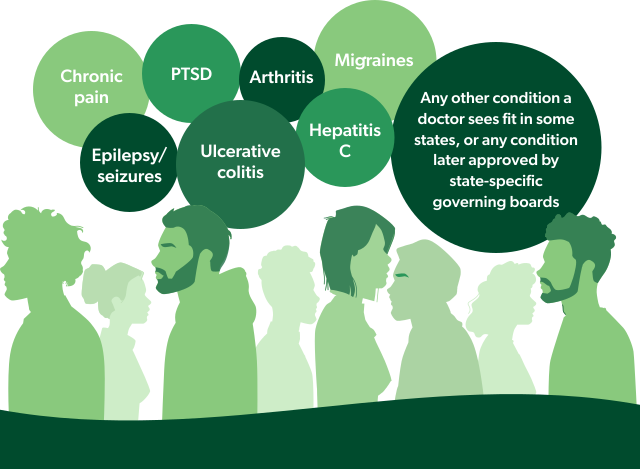
Within the broader pain management continuum, more research is needed to understand the clinical impacts of marijuana, but substantial clinical evidence demonstrates that marijuana can benefit patients experiencing chronic pain, neuropathic pain, spasticity, nausea/vomiting, depression, and anxiety.13-14
However, medical consensus remains mixed. For instance, the Department of Health and Human Services, the FDA, the National Institute on Drug Abuse, and the American Society of Regional Anesthesia and Pain Medicine believe there is credible evidence that marijuana can help treat pain.15-17 In contrast, organizations like the American Medical Association and the CDC remain undecided, while entities like The American College of Physicians and ACOEM believe there is a lack of credible evidence for the use of marijuana in the treatment of pain.18-21
Regardless, research into marijuana’s ability to treat pain, and its relationship to opioid use, has continued.

A 2023 JAMA survey found that among chronic pain patients in medical cannabis programs who used medical cannabis to manage pain, over half said it led them to decrease their use of prescription opioids, prescription nonopioid drugs, and over-the-counter pain medications.22

Another JAMA study looked at 8,165 patients in the New York medical cannabis program who previously received long-term opioid therapy. Patients received medical cannabis and then were sorted into two groups – those who continued using it after 30 days, and those who did not. Among the patients that continued using medical cannabis, opioid MME decreased 47-51%, yet MME only decreased 4-14% in the group that did not continue to use medical cannabis.23

At a population level, a WCRI study from 2023 found that the adoption of state recreational marijuana was associated with a 9.7% decrease in claims with opioids in workers’ comp.24

A 2023 study from Health Economics found that states with legal recreational cannabis laws saw a 26% reduction in the amount of codeine dispensed at retail pharmacies.25
These findings suggest marijuana has influenced opioid utilization in multiple settings, and that the rescheduling of marijuana may increase that impact. However, all of this will be dependent on evolving clinical research and drug development.
As marijuana utilization evolves, pharmacy management considerations remain central. Marijuana is associated with a complex risk profile, including known side effects, adverse events, and drug‑drug or drug‑disease interactions that must be carefully managed.
At this time, there are approximately 403 known drug interactions with marijuana – 28 of them major, such as with various opioids, sedatives, blood thinners, and other commonly used medications.26
Additionally, marijuana can also cause various side effects and adverse events, including:

Given these considerations, managing claims involving marijuana requires flexibility, clinical oversight, and customization, particularly in complex or high‑risk cases. Compounding these challenges is the ongoing lack of standardized clinical guidelines, which continues to create uncertainty around dosing, formulations, routes of administration, and interaction management.
Historically, marijuana transactions in workers’ comp have also posed reimbursement and operational challenges. Injured workers were often required to pay cash for medical marijuana and then request reimbursement, instead of the normal point-of-sale process where the medication is billed to their insurer.
Often these requests were denied based on marijuana’s Schedule I status. Even when approved, the reimbursements still required extra steps due to federal banking restrictions.
Under rescheduling, an FDA-approved marijuana medication would be processed like any other prescription drug, including standard pharmacy and reimbursement workflows. However, it remains unclear at this time if rescheduling will change banking restrictions for currently available medical marijuana products that are not FDA approved.
While rescheduling alone will not resolve the clinical, safety, or reimbursement complexities surrounding marijuana, it represents a meaningful inflection point. Organizations that proactively assess policy, utilization management, and workplace safety implications will be better positioned as regulatory and clinical clarity continues to evolve.

