For more than two decades, drug shortages have plagued the U.S. healthcare market – so much so that the American Medical Association has declared them “an urgent public health crisis.”1 Because 84% of shortages involve generic drugs2, they have a disproportionate impact on injured workers who rely on these generics for early pain control and post-surgical recovery.
And in workers’ compensation, shortages are no longer simply a problem at the pharmacy counter – they are increasingly becoming claims management risks. Medication access delays can alter claim trajectories, resulting in worse health outcomes and prolonged time away from work. On the administrative side, these cases can quickly escalate into more complex, higher-touch claims requiring increased oversight and intervention from claims teams.
To keep claims on track, payers and claims professionals must take a proactive approach – one that involves the ability to anticipate risks, maintain visibility across the claim lifecycle, and coordinate clinical and pharmacy decisions in real time.
The U.S. Food and Drug Administration (FDA) considers a drug to be in shortage when, at the national level, supply is not meeting current demand, or if supply is not forecasted to meet projected demand.3

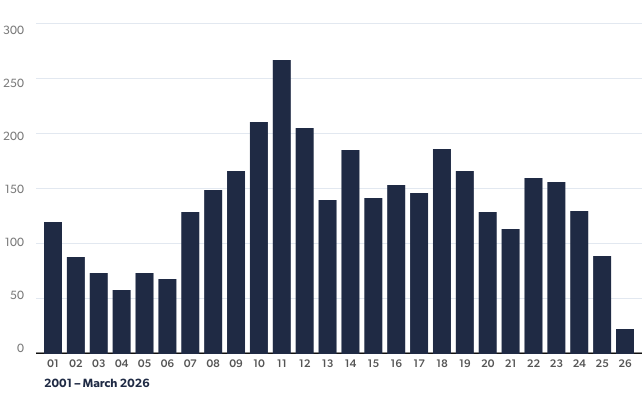
As of June 2026, the FDA was tracking 73 national drug shortages.4 But what’s more telling, over time, is the number of new drug shortages each year. For instance, in 2011, at the height of the drug shortage crisis, there were 267 new shortages. Yet in 2025, there were just 89 new drug shortages – which reflects a gradual decline each year since 2022.5
However, though there has been an overall decrease in new shortages, the shortages are lasting longer, with more than half of the active shortages tracked in 2024 ongoing for more than two years.6 And fewer new shortages doesn’t mean fewer people are impacted, as even a single shortage can affect a large number of patients. By one estimate, the average shortage affects at least half a million consumers.7

Forty-six percent of workers’ compensation industry stakeholders cite healthcare provider, service, or medication shortages as one of their biggest challenges – and for medical program managers and healthcare providers specifically, this is the number one industry challenge.8
Injured workers are particularly affected by drug shortages because they rely on the medications that are often in short supply, such as generics (the rate of generic utilization in workers’ comp had reached 89% in 2023).9 And from 2018 to 2023, there were over twice as many generic shortages as brand drug shortages.10
Additionally, IQVIA data shows that in 2024 national drug shortages were most prevalent in the therapeutic areas of pain management and oncology11 – both of which have a direct impact on injured workers. In fact, pain/anesthesia and oncology have been among the leading causes of shortages over the past decade.12
However, it’s worth noting that current FDA data paints a slightly different picture. As of June 2026, the therapeutic area with the most drug shortages is pediatric. This is followed by anesthesia (tied with several other areas), and then analgesia/addiction. Oncology is even further down the list with fewer shortages.13


The FDA cites manufacturing quality issues as the most common reason for drug shortages, but also mentions these drivers:

Production delays at the manufacturer
Delays receiving raw materials and components from suppliers
Sudden or unexpected increases in demand
Drugs being discontinued by manufacturers16
Current events, such as catastrophic weather and armed conflict, can also contribute to drug shortages. One example is a 2023 tornado that damaged a Pfizer pharmaceutical plant in North Carolina. The plant produces anesthesia and other drugs, as well as nearly 25% of all sterile injectable medications used in U.S. hospitals.
A more recent example is the Strait of Hormuz closure, which began in February 2026 due to the U.S.-Iran conflict. Depending on how long it went on, this could have put generic drugs at risk because the United States relies on the strait for drug manufacturing materials and shipping finished drugs – and nearly half of U.S. generic prescriptions originate in India.17
Across the healthcare system, drug shortages largely impact patients, who may experience higher medication costs, changes or delays in treatment, and adverse health outcomes. They are also a drain on the system itself, which may experience higher labor costs, indemnity costs (due to longer-to-resolve claims), and more administrative burden.
The below examples of these impacts are primarily from group health data. However, the impacts are often even more pronounced in workers’ compensation because of structural and regulatory differences that limit flexibility in managing care (see sidebar: Why Drug Shortages Hit Workers’ Comp Harder).
A 2023 research report on the impacts of drug shortages on consumer costs shows shortage drugs typically experience increases in manufacturer price. The data indicates a 16.6% increase in the price of drugs in shortage, driven mostly by an increase in the price of generics. In some cases, the increase in the price of substitute drugs was at least three times higher than the price increase of the drug in shortage.18
Furthermore, in a survey of pharmacists on the effect of oncology shortages on cancer care, 85% of respondents reported increased medication costs.19 In workers’ comp, where patients are not responsible for prescription costs, cost increases like this are passed directly to the payer.
Labor costs can be affected, too. For instance, in 2023, U.S. hospitals spent 20 million hours managing a range of drug shortages – which translates to nearly $900 million annually in labor costs.20
Drug shortages can lead prescribers to delay treatment while searching for an alternative drug, or to use second-line medications or alternative routes and methods of administration – any of which may be less effective or pose additional risks.
In a survey of pharmacy professionals, over 99% of respondents reported they were experiencing drug shortages. Of these, 32% of respondents categorized the shortages as “critically impactful” – meaning they were rationing, delaying, or canceling treatments or procedures.21
Furthermore, in a survey of cancer patients, one in 10 respondents in active treatment said they were impacted by drug shortages. Of those, 45% said they faced a delayed or missed treatment in their cancer care. And 35% had difficulty using their insurance to fill a prescription related to the shortage, such as facing delays covering a substitute drug.22
When a patient’s treatment must change, it opens the door to adverse events and medication errors. In a survey of pharmacy directors, approximately 40% of respondents reported between one and five adverse events probably or possibly associated with drug shortages at their institution, with the majority reporting between one and 10 medication errors.23
Another survey of healthcare facility leaders shows similar results, with 43% of respondents indicating medication errors that occurred were related to drug shortages. Further, 27% of respondents reported that drug shortages caused disruptions in patient care.24
In the worst cases, drug shortages are associated with higher mortality rates. One study looked at the 2011 U.S. shortage of norepinephrine, used to treat septic shock. Hospitals increasingly used an alternative medication, phenylephrine, during the periods of active norepinephrine shortage. The study concluded that hospital admission during these periods was associated with an increased rate of in-hospital mortality.25
In workers’ comp, delays in medication fulfillment or switches to alternative therapies can be leading indicators of potential claim complexity. A drug shortage can turn what would otherwise be a routine claim into one requiring increased oversight and intervention. Switching to an alternative medication may seem simple, but often requires prescriber outreach, utilization review, or approval – introducing delays that prolong treatment, and subsequently, the lifecycle of the claim.
Medication access delays due to drug shortages often trigger more touches per claim – prescriber outreach, utilization review, documentation demands, and other approvals. This means workers’ comp claims teams are managing more complex, more costly, and more time-consuming cases, adding to their administrative burden when they may already be facing high caseloads.
Drug shortages also raise regulatory questions. With state-specific formulary and treatment guidelines, rules about drug utilization are intended for normal market conditions. However, when there is a drug shortage such as those in the early days of COVID, formulary requirements, prior authorization rules, and dispensing limits may become more difficult to manage – and in some cases could become an additional obstacle to patient care. Regulators, payers, and providers must consider the impact of drug shortages to ensure there is a balance between clinical appropriateness and regulatory compliance when critical medications are unavailable. In extreme cases, regulators may exercise discretion to relax certain requirements.
Drug shortages can quickly turn what might be a manageable clinical issue in group health into a higher-cost, higher-touch claim in workers’ compensation. Here’s why:
Pharmacy Benefit Managers (PBMs) have capabilities in place to identify and resolve medication access challenges in the claims process, including those caused by drug shortages. This coordinated approach might include:
Guidance for pharmacists at the point of dispensing, including real-time drug utilization review (DUR) and step therapy programs that provide evidence-based information on clinically appropriate alternative therapies when prescribed medication is not available.
Real-time adjudication and pharmacy messaging to alert pharmacists and claims stakeholders when a prescription triggers edits or requires additional review – allowing for timely intervention before delays significantly impact treatment.
Routing and escalation capabilities in existing workflows to ensure that medication-related issues are directed to the appropriate resource, such as a claims professional, nurse case manager, or clinical pharmacist.
Clinical oversight programs, including pharmacist review and prescriber outreach, that provide an additional safeguard to ensure any therapy adjustments are appropriate and aligned with evidence-based guidelines.
In an environment where access to medications is not always reliable, the ability to anticipate disruptions and respond with coordinated strategies is essential. By partnering with a PBM and implementing targeted solutions, payers can help prevent routine claims from becoming prolonged or complex and achieve the best outcomes.

